Use the LLM for reasoning. Use Sentiqra when the same input needs the same output every time.
Expose deterministic analyzers as MCP tools your agents call directly - reproducible structured signals inside an otherwise probabilistic system.
Who it's for
Agent platform engineer
Deterministic tools your agents can call.
AI governance
Auditable evidence behind every agent action.
Strong fit if
- Inbound messages or alerts need triage
- Lures and credential threats reach your users
- Security tooling needs structured signals, not prose
The pipeline
Sentiqra supplies the evidence. Your systems decide what happens next.
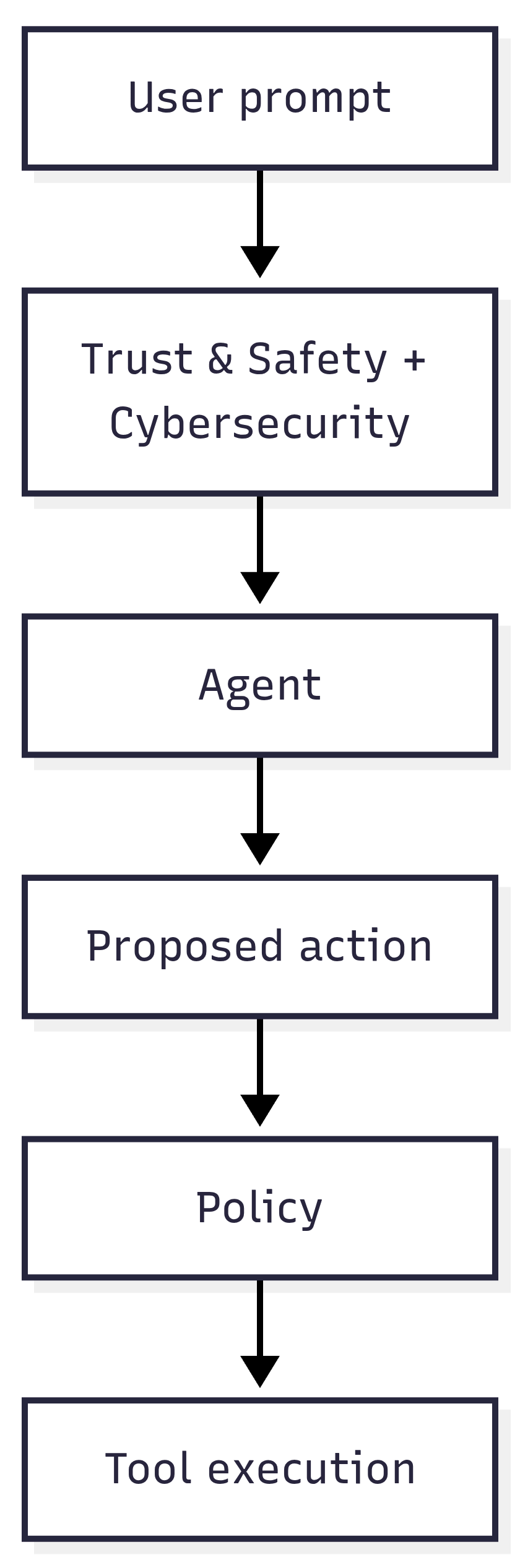
Sentiqra does not make the final decision. It supplies structured signals to the systems that do.
Stored with every decision
Request ID · configuration ID · fingerprint · policy version · action taken
You control: agent policy and tool-execution rules · human approval gates · final action and audit trail
Enforcement belongs at the action boundary - your tool gateway
A check the agent chooses to run is a suggestion, not a guardrail. The enforceable pattern puts required checks inside dispatch: the agent proposes tool + arguments, and your gateway - code the model cannot skip - evaluates the actual proposed action, invokes the required Sentiqra checks itself, applies authorization and policy, then executes or refuses. The reference implementation below mints a signed, single-use approval bound to the tenant, actor, tool, the exact argument digest, the policy version, and a validity interval - mutating any argument after approval invalidates it.
- Analysis is evidence, never a credential: a benign result does not authorize a database read or an outbound email - OWASP treats excessive functionality, permissions, and autonomy as distinct causes of harmful agent behavior.
- Identity comes from your session, not the text: tenant and actor are supplied by your application layer and are never parsed out of analyzed content.
- Blocked, failed, or overloaded checks fail closed - and every decision writes an audit record carrying digests, not content.
Before Sentiqra / With Sentiqra
| Before | With Sentiqra |
|---|---|
| LLM self-classification | Deterministic signal codes |
| Unverifiable agent reasoning | Replayable analysis + fingerprint |
| Implicit policy | Explicit signal → action gate |
What you receive
Not a generic "unsafe" flag - structured signals your policy engine can route on.
- Deterministic signal codes and confidence
- Pinned configuration per call
- Request ID and verification fingerprint
MCP Server - response preview · illustrative
// POST /mcp - JSON-RPC tools/call
{"jsonrpc": "2.0", "id": 1, "method": "tools/call",
 "params": {"name": "detect_trust_safety",
            "arguments": {"text": "<user prompt>", "language": "en"}}}
Three workflows this powers
1
Prompt security enrichment
Screen user input for harmful or credential-risk content before the agent reasons on it.
2
Tool-call evidence
The gateway attaches a reproducible semantic analysis to every executed or refused action - the receipt outlives the reasoning.
3
Human-in-the-loop gates
Route high-risk agent proposals to a human before execution, with the signals that triggered the gate.
Replay any result, exactly.
Every successful analysis result carries a signed verification receipt: a configuration ID (sqcfg_...), a result fingerprint (fp2_...), an input commitment (ic3_...), and an Ed25519 signature (sig_ed25519_...). Keep them with the decision they produced - re-running the same input under the same supported configuration and output profile returns the same canonical result, whether that's an appeal next week or an audit next year.
Proof
Sentiqra sits inside the agent tool list - not as a wrapper around the LLM. The MCP server exposes nine tools: eight single-analyzer detect_* tools plus detect_all, which runs the eight MCP-exposed analyzers in one invocation - so the agent calls a deterministic tool and gets auditable evidence back. Enforcement stays in your tool gateway: the gateway, not the agent, decides which checks run before a privileged action executes.
MCP integrationEvery analyzer on every plan - from Free (5K runs/mo) to Enterprise. See pricing →
Prove fit on your own data.
A 30-minute evaluation path: export real examples, run in parallel, compare signal quality, and replay the receipts.
- 1. Export 100-500 real examples from your workload - including the hard cases.
- 2. Label each with the outcome you actually want (route / hold / allow).
- 3. Run them through the free tier against the analyzers on this page.
- 4. Compare our signals to your labels - where we agree, where we miss.
- 5. Tune your thresholds on the misses, re-run, and confirm the improvement.
- 6. Replay the receipts to confirm identical results - that's your audit trail.
Often paired with: Multi-Domain Orchestration (staged pipelines behind the agent) · Security Operations (credential and threat screening)
Agents that outgrow a single screen usually graduate to Multi-Domain Orchestration - staged pipelines the agent triggers conditionally instead of calling every analyzer on every turn. The gate also decides what downstream analyzers never see, so validate end-to-end recall against an always-on baseline before adopting one.
5,000 analyzer runs/month · No card required