Not every message needs every analyzer. Route conditionally, pay for what fires.
Run a cheap primary screen, then call specialized analyzers only when it warrants - each risk stays visible and routes to the workflow that owns it.
Who it's for
Platform architect
Compose specialized analyzers into one pipeline.
Engineering lead
Lower cost and latency with staged analysis.
Strong fit if
- You compose several analyzers into one pipeline
- Run cost matters at scale
- Different risk types have different owners
The pipeline
Sentiqra supplies the evidence. Your systems decide what happens next.
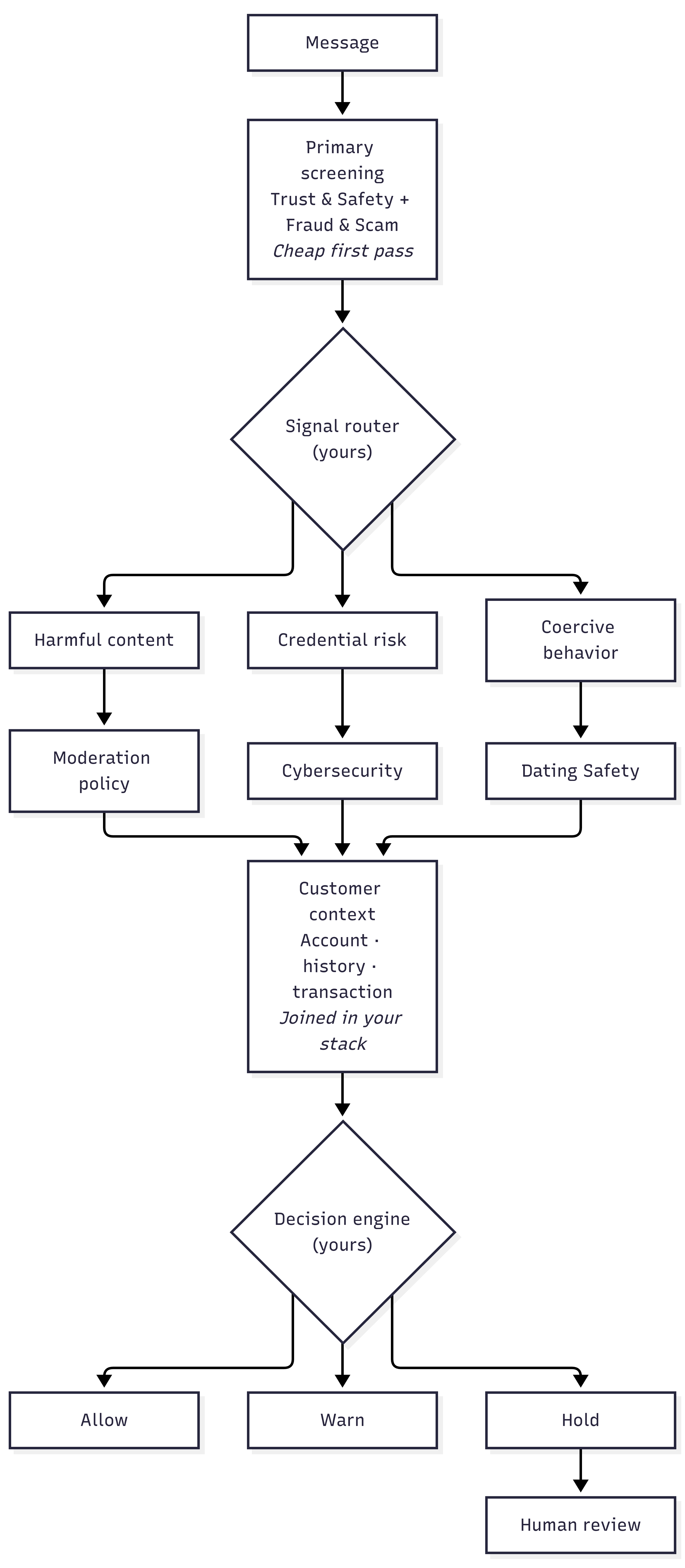
Sentiqra does not make the final decision. It supplies structured signals to the systems that do.
Stored with every decision
Request ID · configuration ID · fingerprint · policy version · action taken
You control: the signal router and decision engine · which analyzers run and when · final action and human review
Before Sentiqra / With Sentiqra
| Before | With Sentiqra |
|---|---|
| One flattened score | Per-domain signals |
| Run everything always | Staged conditional analysis |
| Opaque routing | Explicit signal → workflow mapping |
What you receive
Not a generic "unsafe" flag - structured signals your policy engine can route on.
- Per-domain signals from specialized analyzers
- Staged, conditional analysis
- A unified evidence trail across domains
All Analyzers - response preview · illustrative
Three workflows this powers
1
Staged risk pipelines
Run a cheap primary screen, then call specialized analyzers conditionally - 8M messages at 1.15 analyzers average is 9.2M runs, not 32M.
2
Domain-owned routing
Send each risk type to the workflow that owns it - moderation, fraud, security - instead of flattening every risk into one score.
3
Unified evidence trail
Keep one auditable record across every analyzer that ran: which domain fired, at what confidence, under which configuration.
A gate decides what specialists never see
A conditional screen saves runs, but it also filters the specialist's input. If the gate passes 95% of relevant cases and the specialist detects 95% of what reaches it, end-to-end recall is 0.95 × 0.95 = 0.9025 - measured as conditional rates, with no independence assumption. Before you commit to a routing rule, replay the frozen workflow (sentiqra/workflow/v1) against a baseline that runs every specialist directly and measure the relevant cases each upstream gate excludes.
- Freeze routing rules and the full configuration set per workflow version - reprocessing reproduces both routing decisions and the final policy outcome.
- Every stage records completed, failed, or deliberately skipped. A skipped analyzer is never a negative finding.
- Domain signals stay separate - a combined decision model needs its own validation; scores are not multiplied or averaged into a probability.
What the first 30 days look like
Week 1
Map your current flow: which texts hit which analyzers today, and where a cheap screen could gate the expensive calls.
Week 2
Stand up the primary screen (T&S + Fraud & Scam) on a sample of real traffic.
Week 3
Wire the conditional router - Cybersecurity/Dating Safety only when primary signals warrant.
Week 4
Measure the analyzer-run ratio on live traffic and lock the thresholds that keep it near your target.
Replay any result, exactly.
Every successful analysis result carries a signed verification receipt: a configuration ID (sqcfg_...), a result fingerprint (fp2_...), an input commitment (ic3_...), and an Ed25519 signature (sig_ed25519_...). Keep them with the decision they produced - re-running the same input under the same supported configuration and output profile returns the same canonical result, whether that's an appeal next week or an audit next year.
Proof
The math is the pitch: staged analysis cuts analyzer-run cost and keeps p95 under 500ms in our current internal benchmark by only paying for what fires.
Performance Dashboard snapshotEvery analyzer on every plan - from Free (5K runs/mo) to Enterprise. See pricing →
Prove fit on your own data.
A 30-minute evaluation path: export real examples, run in parallel, compare signal quality, and replay the receipts.
- 1. Export 100-500 real examples from your workload - including the hard cases.
- 2. Label each with the outcome you actually want (route / hold / allow).
- 3. Run them through the free tier against the analyzers on this page.
- 4. Compare our signals to your labels - where we agree, where we miss.
- 5. Tune your thresholds on the misses, re-run, and confirm the improvement.
- 6. Replay the receipts to confirm identical results - that's your audit trail.
Often paired with: Marketplace & Messaging Safety (the canonical multi-analyzer use case) · Security Operations (conditional Cybersecurity escalation)
Marketplace & Messaging Safety is the canonical deployment of this pattern - if that page describes your traffic, start there and come back when the primary screen earns its keep.
5,000 analyzer runs/month · No card required