Not just abuse. Not just fraud. Not just impersonation. All three, in the same conversation.
Scam behavior, credential theft, coercion, and account abuse can appear in a single conversation. Sentiqra runs specialized analyzers over the same message and keeps each risk visible - routed to the workflow that owns it.
Who it's for
Marketplace trust lead
Catch scams and abuse in the same conversation.
Fraud ops
Route scam signals to holds and review before money moves.
Platform engineer
Compose analyzers into one staged pipeline.
Strong fit if
- You route, hold, or remove content at volume
- Users appeal enforcement decisions
- Legal or regulators ask "why this action"
The pipeline
Sentiqra supplies the evidence. Your systems decide what happens next.
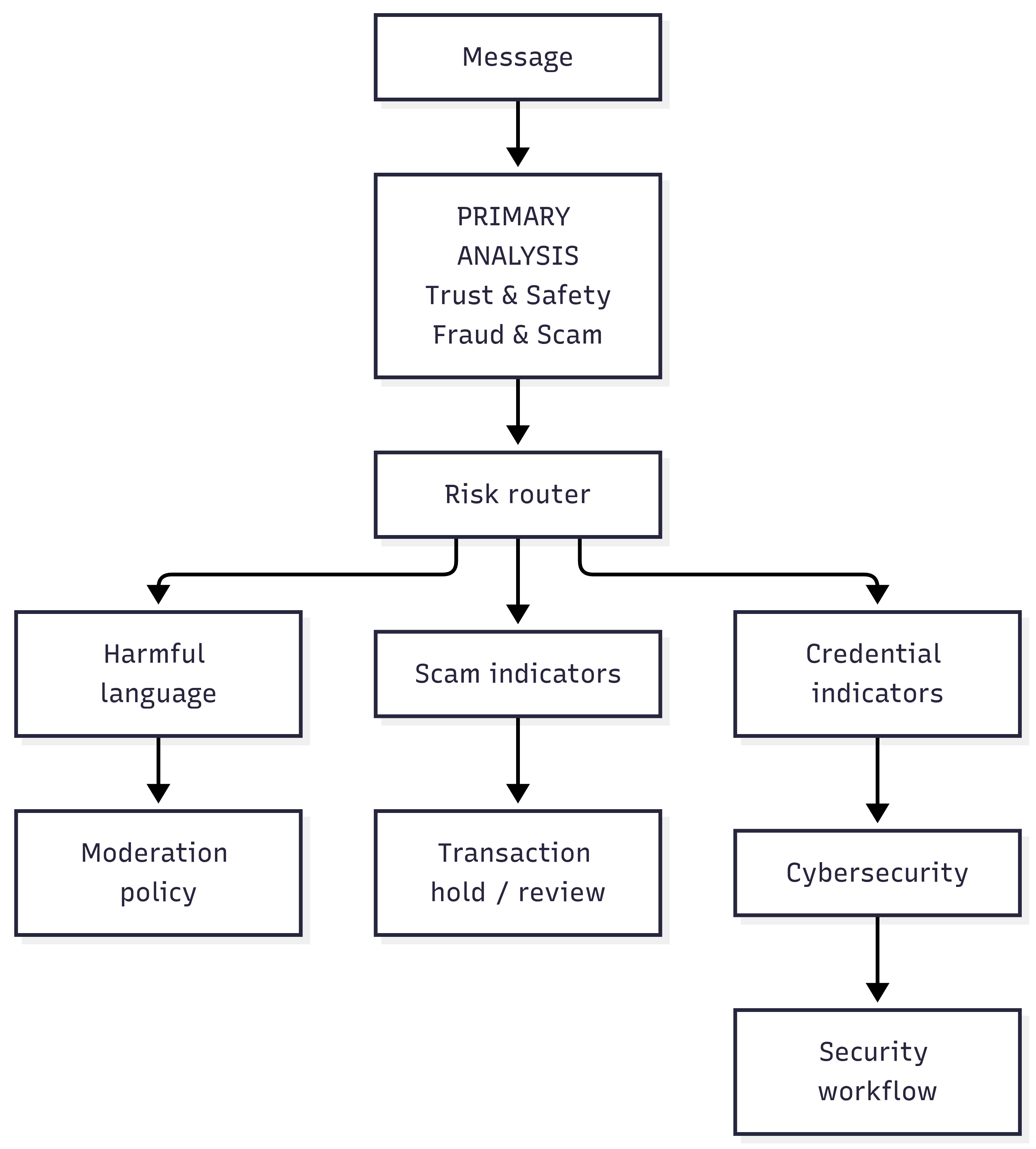
Sentiqra does not make the final decision. It supplies structured signals to the systems that do.
Stored with every decision
Request ID · configuration ID · fingerprint · policy version · action taken
You control: transaction holds and messaging friction · verification requests and user warnings · fraud-review routing and escalation · repeat-abuse investigation priority
Before Sentiqra / With Sentiqra
| Before | With Sentiqra |
|---|---|
| One flattened risk score | Per-domain signals |
| Single general classifier | Specialized analyzers |
| Ambiguous enforcement | Explicit signal → action routing |
What you receive
Not a generic "unsafe" flag - structured signals your policy engine can route on.
- Per-domain risk signals (abuse, scam, credential threat)
- Confidence scores per signal
- Versioned configuration and fingerprint
Trust & Safety - response preview · illustrative
POST /v1/analyze
{"text": "check my profile then send deposit", "language": "en",
 "analyzers": ["trust-safety", "fraud-scam"]}
# credential-lure phrase also screened by cybersecurity in the same request
Three workflows this powers
1
Transaction protection
Hold or flag transactions when conversation signals indicate scam behavior - before money moves, not after the dispute.
2
Messaging friction
Insert warnings or verification steps when risk signals cross your threshold, without blocking legitimate commerce.
3
Fraud-review routing
Send conversations with scam indicators to a specialist queue while moderation handles the abuse signals - same message, two owners.
A gate decides what specialists never see
Staging the multi-analyzer pass behind a primary screen saves runs, but the screen also filters the specialist's input. If the gate passes 95% of relevant cases and the specialist detects 95% of what reaches it, end-to-end recall is 0.95 × 0.95 = 0.9025 - measured as conditional rates, with no independence assumption. Before locking flag thresholds, replay the frozen workflow (sentiqra/workflow/v1) against a baseline that runs every analyzer directly and measure the relevant cases the screen excludes.
- Freeze routing rules and the full configuration set per workflow version - reprocessing reproduces both routing decisions and the final policy outcome.
- Every stage records completed, failed, or deliberately skipped. A skipped analyzer is never a negative finding.
- Domain signals stay separate - a combined decision model needs its own validation; scores are not multiplied or averaged into a probability.
Replay any result, exactly.
Every successful analysis result carries a signed verification receipt: a configuration ID (sqcfg_...), a result fingerprint (fp2_...), an input commitment (ic3_...), and an Ed25519 signature (sig_ed25519_...). Keep them with the decision they produced - re-running the same input under the same supported configuration and output profile returns the same canonical result, whether that's an appeal next week or an audit next year.
Proof
The differentiator is parallel coverage: Trust & Safety, fraud, and cybersecurity signals on the same message, each routed to the team that owns it. Modeled on a marketplace screening 2M conversations/mo: ~1.4 analyzers average is 2.8M runs - a third of the cost of blanket-running all three.
Trust & Safety + Fraud & Scam on every plan - from Free (5K runs/mo) to Enterprise. See pricing →
Prove fit on your own data.
A 30-minute evaluation path: export real examples, run in parallel, compare signal quality, and replay the receipts.
- 1. Export 100-500 real examples from your workload - including the hard cases.
- 2. Label each with the outcome you actually want (route / hold / allow).
- 3. Run them through the free tier against the analyzers on this page.
- 4. Compare our signals to your labels - where we agree, where we miss.
- 5. Tune your thresholds on the misses, re-run, and confirm the improvement.
- 6. Replay the receipts to confirm identical results - that's your audit trail.
Often paired with: Content Moderation (the underlying abuse layer) · Phishing & Account Protection (credential lures inside conversations)
Most teams stage it: Content Moderation as the primary screen, then this page's multi-analyzer pass only on flagged conversations - that's where the run savings come from. The screen also decides which conversations the specialist pass never sees - validate end-to-end recall before locking thresholds.
5,000 analyzer runs/month · No card required