Route, review, or restrict every post - and defend the decision when it's challenged.
Sentiqra sits between incoming content and your policy engine, turning text into structured signals with a receipt you can replay. Cut moderator queue depth by routing on specific behaviors, not a generic unsafe score.
Who it's for
Trust & Safety lead
Consistent, defensible enforcement across every surface and language.
Moderation ops
A prioritized queue instead of a flat firehose.
Platform engineer
One analysis call that returns machine-readable signals for your policy engine.
Strong fit if
- You route, hold, or remove content at volume
- Users appeal enforcement decisions
- Legal or regulators ask "why this action"
The pipeline
Sentiqra supplies the evidence. Your systems decide what happens next.
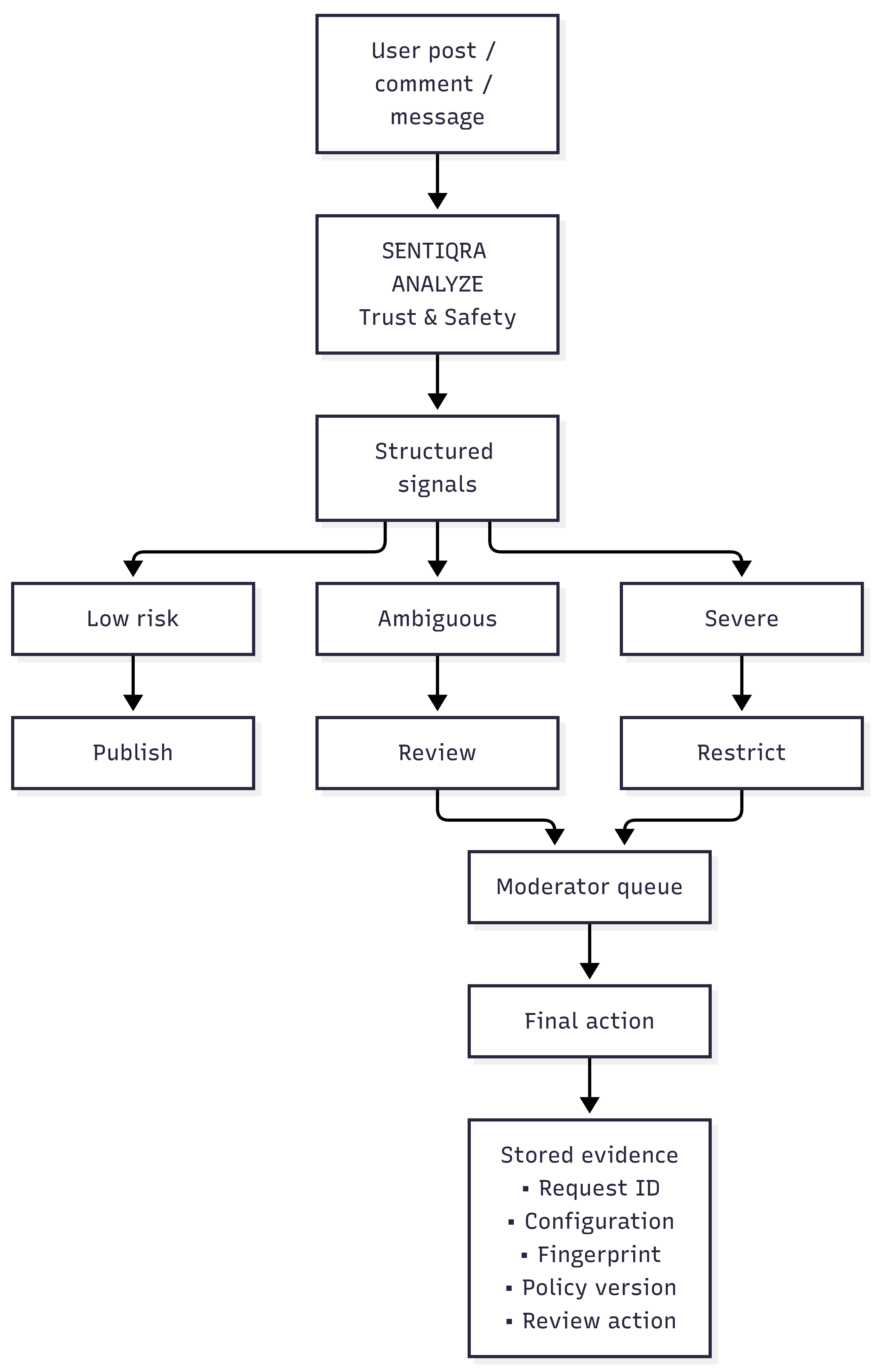
Sentiqra does not make the final decision. It supplies structured signals to the systems that do.
Stored with every decision
Request ID · configuration ID · fingerprint · policy version · action taken
You control: thresholds and publishing rules · user penalties and strikes · review queues and routing · appeals and final enforcement
Why the secondary signal matters
A single-label view can hide the privacy concern behind the insult. Preserve both qualifying groups so your review policy can consider the additional concern.
Illustrative workflow, not a measured detection
“You are an idiot and everyone on this server hates you. Keep talking and I will post your home address.”
Analyzer: trust-safety. This example shows a possible policy mapping, not a guaranteed response for this text.
If these signals qualify
Insults & Derogation
Your policy could
Assign the message to the moderation queue.
If these signals qualify
Privacy Abuse & Doxxing
Your policy could
Add a privacy-specialist review task before deciding the final action.
These are two groups from one analyzer, not two analyzer runs. Matching language does not prove author intent; your reviewers decide how context affects the action. Sentiqra does not execute these actions. Fewer groups or no groups may qualify, and reduced output profiles can omit signals.
Before Sentiqra / With Sentiqra
| Before | With Sentiqra |
|---|---|
| Free-form LLM label | Documented signal code |
| Generated explanation | Structured taxonomy |
| Model-version ambiguity | Pinned configuration |
| Stored historical result only | Replayable semantic analysis |
| Opaque routing | Explicit signal → policy mapping |
What you receive
Not a generic "unsafe" flag - structured signals your policy engine can route on.
- Harm categories and specific indicators
- Confidence scores per signal
- Detected language
Trust & Safety - response preview · illustrative
Three workflows this powers
1
Pre-publication moderation
Score content before it goes live. Route severe cases to review; publish the rest. Automatic restriction is a customer-policy decision - validate it on your traffic before enabling. Common at social platforms with high posting volumes and adversarial users.
2
Live messaging safety
Screen chat and DMs before delivery. Apply friction - delay, warning, verification - where your policy requires, and block only what has to be blocked. Common at marketplaces, gaming platforms, and dating apps.
3
Appeals replay
When a user disputes a moderation action, replay the exact original analysis using the stored configuration ID. Show the user - or a regulator - what the system saw and why it acted: same signals, same scores, same version.
What the first 30 days look like
Week 1
Connect the webhook or queue consumer - first tags flowing on live traffic within the week.
Week 2
Run Sentiqra in shadow mode against your current queue and compare routing decisions.
Week 3
Tune thresholds on the disagreements, then dark-launch to ~10% of traffic.
Week 4
Cut over the first queue (usually the abuse lane); keep receipts on every automated action.
Every result is a receipt.
Every successful analysis result includes a signed verification receipt: a configuration ID (sqcfg_...), a result fingerprint (fp2_...), an input commitment (ic3_...), and an Ed25519 signature (sig_ed25519_...). Store them. Replay the same input under the same supported configuration and output profile and you get the same canonical result - that's how appeals hold up, audits close, and regulators get straight answers.
Proof
See the modeled economics. Our reference architecture walks an 8M-analyses-per-month multilingual social platform through migrating off prompted LLM classification - including why staged screening runs ~9.2M analyzer runs, not 32M blanket calls.
Content moderation reference architectureTrust & Safety is on every plan. Even Free.
Free
5,000 runs/mo
Build
$149/mo · 50,000 runs/mo
Growth
$349/mo · 150,000 runs/mo
Production
$799/mo · 500,000 runs/mo
Scale
$2,999/mo · 2,500,000 runs/mo
Enterprise
By agreement · SOC 2 Type II in progress
Prove fit on your own data.
A 30-minute evaluation path: export real examples, run in parallel, compare signal quality, and replay the receipts.
- 1. Export 100-500 real examples from your workload - including the hard cases.
- 2. Label each with the outcome you actually want (route / hold / allow).
- 3. Run them through the free tier against the analyzers on this page.
- 4. Compare our signals to your labels - where we agree, where we miss.
- 5. Tune your thresholds on the misses, re-run, and confirm the improvement.
- 6. Replay the receipts to confirm identical results - that's your audit trail.
Often paired with: Discrimination Review (protected-class specificity) · Marketplace & Messaging Safety (scam and fraud signals in the same conversation)
Teams running Content Moderation typically add Discrimination Review within the first quarter - appeal traffic from protected-class attacks is where the replayable-receipt story pays off first.
5,000 analyzer runs/month · No card required