Detect discriminatory language and exclusion patterns with reviewable evidence.
Screen text for protected-class bias and exclusionary framing before it reaches users, applicants, or decisions. Structured signals for human review - never an automated verdict.
Who it's for
Compliance officer
Auditable evidence behind every flagged decision.
Platform trust lead
Consistent bias detection across surfaces.
What this does not do
- -This detects language patterns - it does NOT determine whether unlawful discrimination occurred.
- -It does not make or recommend hiring, firing, or promotion decisions.
- -It does not score a person as "biased" - it flags text for human review.
- -It does not replace legal counsel or compliance review.
Strong fit if
- You route, hold, or remove content at volume
- Users appeal enforcement decisions
- Legal or regulators ask "why this action"
The pipeline
Sentiqra supplies the evidence. Your systems decide what happens next.
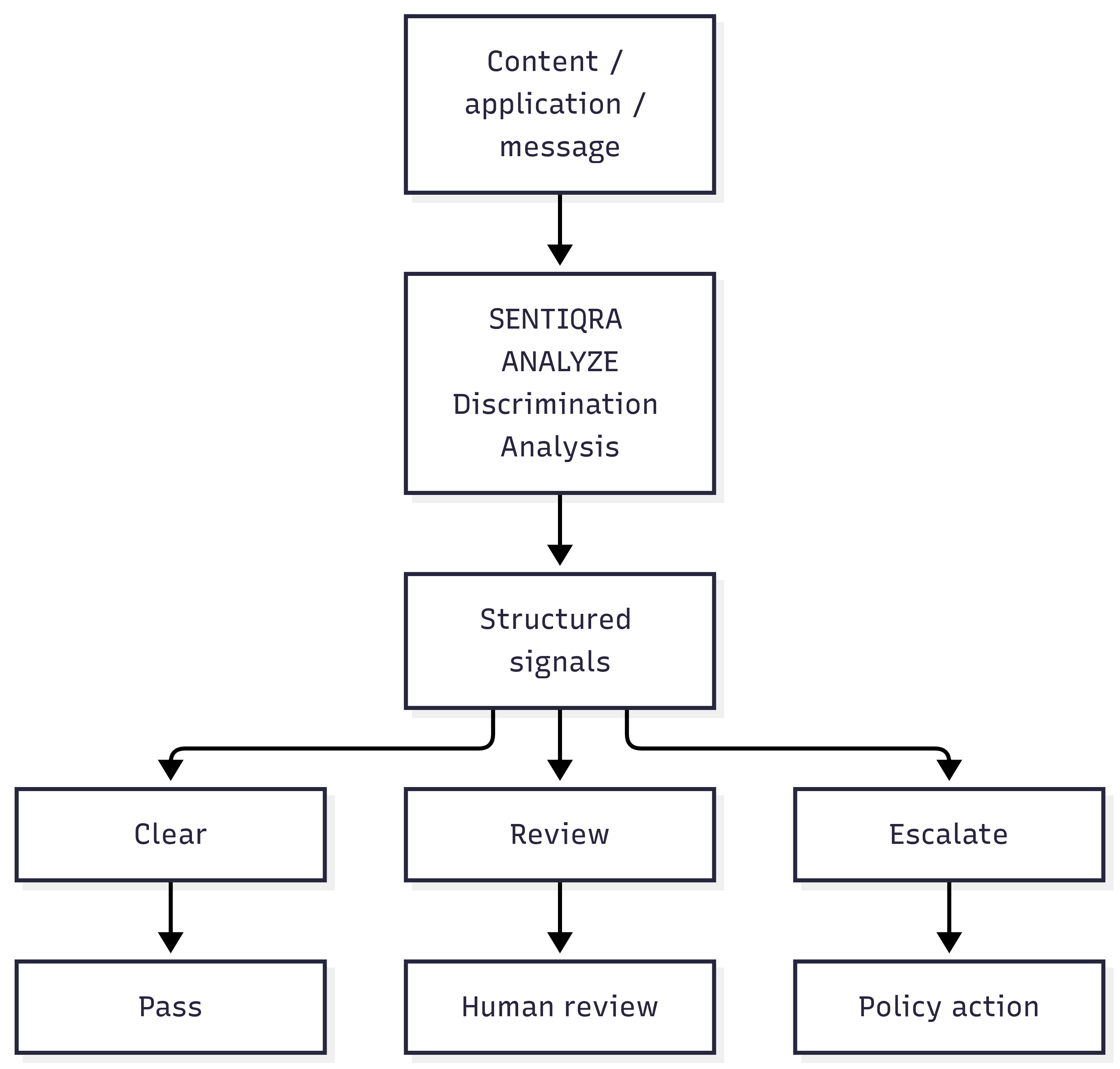
Sentiqra does not make the final decision. It supplies structured signals to the systems that do.
Stored with every decision
Request ID · configuration ID · fingerprint · policy version · action taken
You control: review thresholds and escalation rules · policy and compliance workflows · final determination and remediation
Before Sentiqra / With Sentiqra
| Before | With Sentiqra |
|---|---|
| Generic toxicity score | Protected-class signal codes |
| Generated explanation | Structured taxonomy |
| Unverifiable flag | Replayable analysis |
What you receive
Not a generic "unsafe" flag - structured signals your policy engine can route on.
- Protected-class bias categories and indicators
- Confidence scores per signal
- Versioned configuration and fingerprint
Discrimination Analysis - response preview · illustrative
Three workflows this powers
1
Content screening
Flag exclusionary or biased language in posts, listings, and profiles before publication.
2
Hiring & HR review
Screen communications and documents for protected-class bias - with evidence counsel can review, not a verdict.
3
Compliance audit
Produce structured, replayable evidence for discrimination review and reporting.
Every result is a receipt.
Every successful analysis result includes a signed verification receipt: a configuration ID (sqcfg_...), a result fingerprint (fp2_...), an input commitment (ic3_...), and an Ed25519 signature (sig_ed25519_...). Store them. Replay the same input under the same supported configuration and output profile and you get the same canonical result - that's how appeals hold up, audits close, and regulators get straight answers.
Proof
When a GDPR Article 22 challenge lands - "meaningful information about the logic involved" - the receipt answers it: which signals fired, at what confidence, under which pinned configuration. Reproducible evidence is the legal-defensibility story, not a logo wall.
The full boundary statementDiscrimination Analysis on every plan - from Free (5K runs/mo) to Enterprise. See pricing →
Prove fit on your own data.
A 30-minute evaluation path: export real examples, run in parallel, compare signal quality, and replay the receipts.
- 1. Export 100-500 real examples from your workload - including the hard cases.
- 2. Label each with the outcome you actually want (route / hold / allow).
- 3. Run them through the free tier against the analyzers on this page.
- 4. Compare our signals to your labels - where we agree, where we miss.
- 5. Tune your thresholds on the misses, re-run, and confirm the improvement.
- 6. Replay the receipts to confirm identical results - that's your audit trail.
Often paired with: Content Moderation (the broader abuse layer) · Customer Support Intelligence (routing flagged HR cases)
Most teams get here from Content Moderation: once protected-class appeals start, a generic abuse signal isn't specific enough to defend - this is.
5,000 analyzer runs/month · No card required