Every ticket looks the same in the queue until someone reads it. Route before that read happens.
Intent, urgency, churn risk, emotion, abuse, and security signals across 18 languages - webhook in, tags out, before an agent opens the case. Works alongside Zendesk, Intercom, and Freshdesk.
Who it's for
Support ops lead
A prioritized, routed queue.
CX manager
Consistent QA and escalation metrics.
Security liaison
Account-risk cases routed to the right team.
Strong fit if
- Inbound volume outgrows manual triage
- Routing by keyword misses intent and emotion
- Escalations surface too late
The pipeline
Sentiqra supplies the evidence. Your systems decide what happens next.
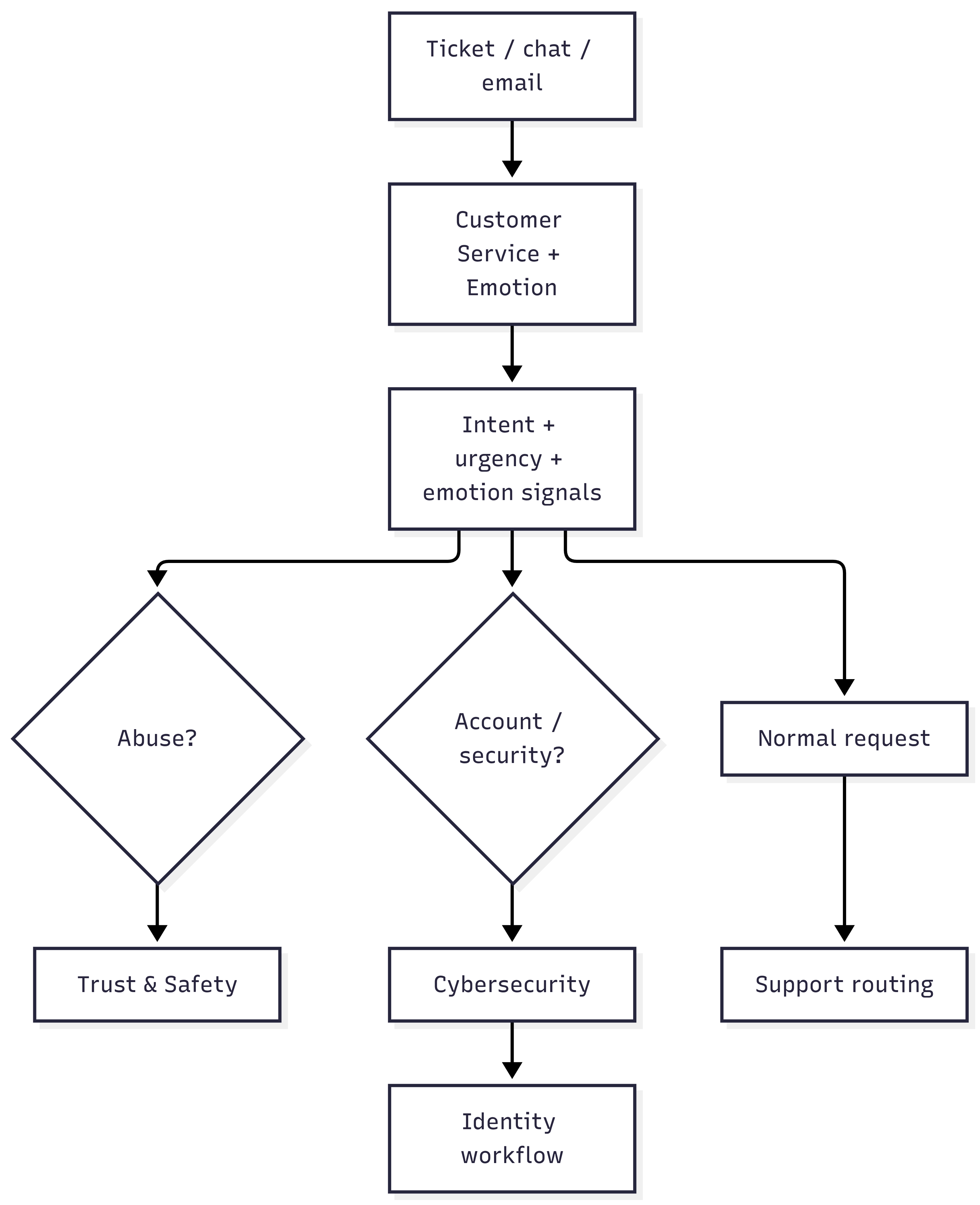
Sentiqra does not make the final decision. It supplies structured signals to the systems that do.
Stored with every decision
Request ID · configuration ID · fingerprint · policy version · action taken
You control: routing and prioritization rules · specialist and identity workflows · qa analytics and agent protection
Why the secondary signal matters
A billing-only label can hide a cancellation and escalation concern. Keep qualifying secondary groups visible so your policy can assign an owner and decide whether specialist follow-up is needed.
Illustrative workflow, not a measured detection
“I have been charged twice this month and your support line keeps dropping me. If this is not fixed today I am cancelling.”
Analyzer: customer-service. This example shows a possible policy mapping, not a guaranteed response for this text.
If these signals qualify
Billing Retention
Your policy could
Assign a billing owner and flag the cancellation concern.
If these signals qualify
Escalation Urgency
Your policy could
Consider senior review using your validated priority rules.
These groups come from Customer Service Intelligence alone. Emotion or security analysis is a separate analyzer run. Cancellation-related language is not proof the customer will leave. Sentiqra does not execute these actions. Fewer groups or no groups may qualify, and reduced output profiles can omit signals.
Before Sentiqra / With Sentiqra
| Before | With Sentiqra |
|---|---|
| Read then route | Route before reading |
| Flat queue | Intent + urgency + risk signals |
| Agents read abuse | Abuse flagged before exposure |
What you receive
Not a generic "unsafe" flag - structured signals your policy engine can route on.
- Issue type, urgency, and escalation indicators
- Emotion, churn/frustration, and abuse signals
- Security-risk indicators
Customer Service Intelligence - response preview · illustrative
Three workflows this powers
1
Auto-routing at scale
A webhook on every new ticket: Sentiqra returns intent + urgency labels, the helpdesk applies tags, routing rules do the rest. Cancel-intent tickets never wait behind password resets.
2
Agent protection
Abuse-detected-before-agent-reads-it - Trust & Safety signals route hostile tickets to specialized handling before an agent opens them.
3
Multilingual unified routing
18 languages, one taxonomy: a billing dispute in Japanese and one in Arabic get the same label and the same queue.
What the first 30 days look like
Week 1
Connect the webhook from your helpdesk - first tickets tagged within the week.
Week 2
Map signal labels to queues in shadow mode; compare against your current routing.
Week 3
Dark-launch to ~10% of tickets and measure routing accuracy on the disagreements.
Week 4
Cut over the retention queue first - that's where the churn-signal payoff shows up fastest.
Replay any result, exactly.
Every successful analysis result carries a signed verification receipt: a configuration ID (sqcfg_...), a result fingerprint (fp2_...), an input commitment (ic3_...), and an Ed25519 signature (sig_ed25519_...). Keep them with the decision they produced - re-running the same input under the same supported configuration and output profile returns the same canonical result, whether that's an appeal next week or an audit next year.
Proof
Labels map to helpdesk queues 1:1 - retention, escalation, security, billing. Modeled on a 60K-ticket/mo queue: tagging every ticket upfront costs 60K runs and cuts the manual first-read on roughly all of them; escalating the ~15% that carry churn or security signals is where the staffing math pays back.
Customer Service Intelligence is on every plan. Even Free.
Free
5,000 runs/mo
Build
$149/mo · 50,000 runs/mo
Growth
$349/mo · 150,000 runs/mo
Production
$799/mo · 500,000 runs/mo
Scale
$2,999/mo · 2,500,000 runs/mo
Enterprise
By agreement · SOC 2 Type II in progress
Prove fit on your own data.
A 30-minute evaluation path: export real examples, run in parallel, compare signal quality, and replay the receipts.
- 1. Export 100-500 real examples from your workload - including the hard cases.
- 2. Label each with the outcome you actually want (route / hold / allow).
- 3. Run them through the free tier against the analyzers on this page.
- 4. Compare our signals to your labels - where we agree, where we miss.
- 5. Tune your thresholds on the misses, re-run, and confirm the improvement.
- 6. Replay the receipts to confirm identical results - that's your audit trail.
Often paired with: Emotion & Escalation (frustration and churn signals on the same ticket) · Security Operations (account-security cases out of the support queue)
Support ops teams almost always add Emotion & Escalation next - intent tells you what the ticket is about, emotion tells you how urgent it feels to the customer.
5,000 analyzer runs/month · No card required