Churn shows up in the report six months late. It shows up in the message today.
Score customer communication for frustration, urgency, and escalation signals - and route at-risk cases to a save motion before the cancellation ticket exists.
Who it's for
CX lead
Early churn and escalation signals.
Retention team
At-risk customers routed to a save motion.
QA / workforce lead
Sample interactions by emotion signal instead of randomly.
Strong fit if
- Inbound volume outgrows manual triage
- Routing by keyword misses intent and emotion
- Escalations surface too late
The pipeline
Sentiqra supplies the evidence. Your systems decide what happens next.
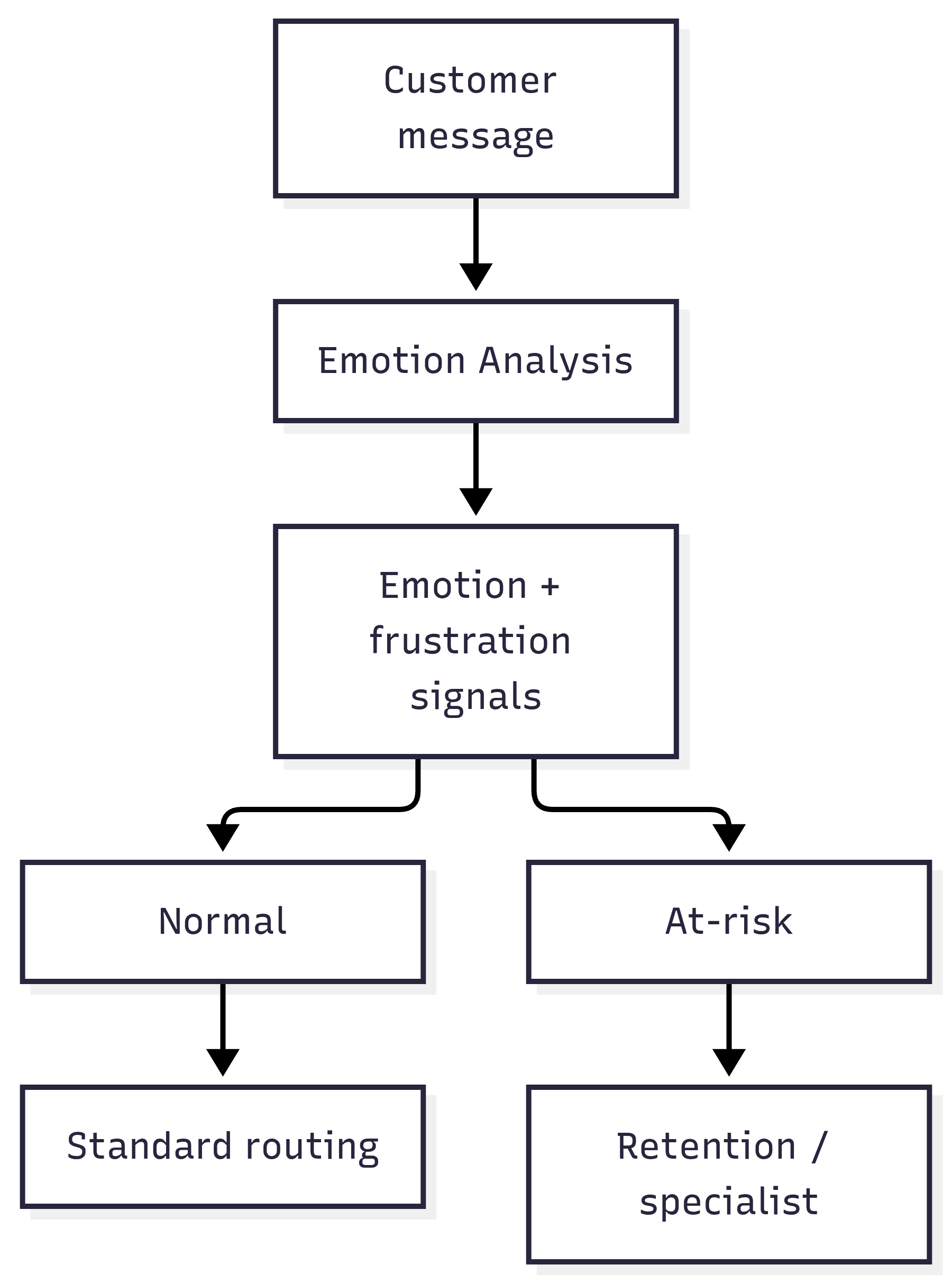
Sentiqra does not make the final decision. It supplies structured signals to the systems that do.
Stored with every decision
Request ID · configuration ID · fingerprint · policy version · action taken
You control: retention and escalation routing · specialist assignment · cx analytics and alerting
Before Sentiqra / With Sentiqra
| Before | With Sentiqra |
|---|---|
| Churn found in a metric | Churn risk found in the text |
| Flat escalation | Emotion-aware routing |
| Random QA sampling | Emotion-targeted review |
What you receive
Not a generic "unsafe" flag - structured signals your policy engine can route on.
- Emotion categories and specific signals
- Frustration and escalation indicators
- Confidence scores per signal
Emotion Analysis - response preview · illustrative
Three workflows this powers
1
Churn-risk detection
Flag frustrated or escalating customers for retention outreach - before they file the cancellation ticket, not after.
2
Escalation routing
Send high-emotion cases to senior or specialist agents while routine requests stay in the standard queue.
3
CX trend analytics
Track emotion and frustration trends across the support surface - a reproducible time series, not vibes.
4
Agent burnout guardrails
Route high-negativity days off an agent's queue - rotation driven by measured emotional load, not gut feel.
Deterministic by construction, provable by receipt.
A signed verification receipt - configuration ID (sqcfg_...), result fingerprint (fp2_...), input commitment (ic3_...), and Ed25519 signature (sig_ed25519_...) - ships with every successful analysis result. Pin it to the stored decision and a later replay under the same supported configuration and output profile yields the identical canonical result - the difference between "the model said so" and evidence.
Proof
20 distinct emotions - frustration, urgency, disappointment - not a positive/negative axis. The simplest analyzer on the platform.
Emotion benchmarksEmotion Analysis on every plan - from Free (5K runs/mo) to Enterprise. See pricing →
Prove fit on your own data.
A 30-minute evaluation path: export real examples, run in parallel, compare signal quality, and replay the receipts.
- 1. Export 100-500 real examples from your workload - including the hard cases.
- 2. Label each with the outcome you actually want (route / hold / allow).
- 3. Run them through the free tier against the analyzers on this page.
- 4. Compare our signals to your labels - where we agree, where we miss.
- 5. Tune your thresholds on the misses, re-run, and confirm the improvement.
- 6. Replay the receipts to confirm identical results - that's your audit trail.
Often paired with: Customer Support Intelligence (intent and urgency routing alongside emotion) · Content Moderation (when frustration turns abusive)
This page usually rides along with Customer Support Intelligence - intent routes the ticket, emotion decides how fast it needs a human.
5,000 analyzer runs/month · No card required