Your analysts cannot read every report. Narrow the stream they inspect.
Screen multilingual reports, news, field updates, and OSINT streams across 21 languages - Ukrainian, Russian, Hebrew, Turkish among them - and surface only the events that deserve attention.
Who it's for
Intelligence analyst
A prioritized queue instead of a firehose.
OSINT lead
Normalized event signals across languages.
Strong fit if
- Analysts triage high-volume multilingual text
- Coverage must hold outside English
- Reports have to be reproducible later
The pipeline
Sentiqra supplies the evidence. Your systems decide what happens next.
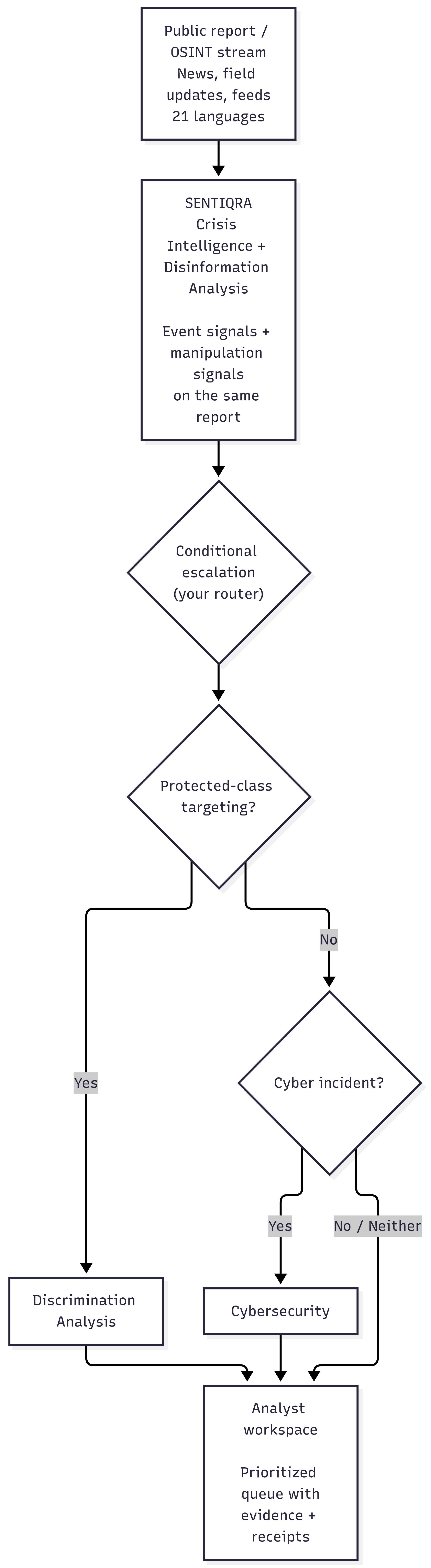
Sentiqra does not make the final decision. It supplies structured signals to the systems that do.
Stored with every decision
Request ID · configuration ID · fingerprint · policy version · action taken
You control: analyst routing and prioritization · watchlists and escalation thresholds · situation reporting and correlation
Before Sentiqra / With Sentiqra
| Before | With Sentiqra |
|---|---|
| Read every report | Screen to a reviewable queue |
| Manual tagging | Structured event signals |
| Single-language tooling | One multilingual interface |
What you receive
Not a generic "unsafe" flag - structured signals your policy engine can route on.
- Crisis-event categories and indicators
- Confidence scores per signal
- Detected language and versioned configuration
Crisis Intelligence - response preview · illustrative
Three workflows this powers
1
Crisis event monitoring
Screen streams for displacement, access, and escalation signals - the 90% that was not relevant never reaches the analyst.
2
Conflict escalation queues
Prioritize reports that indicate deteriorating situations across 21 languages, including Ukrainian, Russian, Hebrew, and Turkish.
3
Program evaluation
Reproduce a historical analysis for a post-crisis report - same corpus, same pinned configuration, same signals.
A gate decides what specialists never see
Conditional escalation saves analyzer runs, but the escalation rule also filters what Discrimination Analysis and Cybersecurity receive. If the gate passes 95% of relevant cases and the specialist detects 95% of what reaches it, end-to-end recall is 0.95 × 0.95 = 0.9025 - measured as conditional rates, with no independence assumption. Before adopting the router, replay the frozen workflow (sentiqra/workflow/v1) against a baseline that runs each escalated analyzer directly and measure the relevant cases the rule excludes.
- Freeze routing rules and the full configuration set per workflow version - reprocessing reproduces both routing decisions and the final policy outcome.
- Every stage records completed, failed, or deliberately skipped. A skipped analyzer is never a negative finding.
- Domain signals stay separate - a combined decision model needs its own validation; scores are not multiplied or averaged into a probability.
Replay any result, exactly.
Every successful analysis result carries a signed verification receipt: a configuration ID (sqcfg_...), a result fingerprint (fp2_...), an input commitment (ic3_...), and an Ed25519 signature (sig_ed25519_...). Keep them with the decision they produced - re-running the same input under the same supported configuration and output profile returns the same canonical result, whether that's an appeal next week or an audit next year.
Proof
21 languages including the ones crises actually unfold in - Ukrainian, Russian, Hebrew, Turkish, Polish, and 16 more.
Per-language benchmarksCrisis Intelligence on every plan - from Free (5K runs/mo) to Enterprise. See pricing →
Prove fit on your own data.
A 30-minute evaluation path: export real examples, run in parallel, compare signal quality, and replay the receipts.
- 1. Export 100-500 real examples from your workload - including the hard cases.
- 2. Label each with the outcome you actually want (route / hold / allow).
- 3. Run them through the free tier against the analyzers on this page.
- 4. Compare our signals to your labels - where we agree, where we miss.
- 5. Tune your thresholds on the misses, re-run, and confirm the improvement.
- 6. Replay the receipts to confirm identical results - that's your audit trail.
Often paired with: Information Integrity (manipulation signals in the same feed) · Multi-Domain Orchestration (conditional escalation to other analyzers)
Crisis feeds are also manipulation feeds - most analyst teams pair this with Information Integrity so event detection and narrative tracking run on the same stream.
5,000 analyzer runs/month · No card required