Detect manipulation techniques - not political viewpoints.
Sentiqra flags how a narrative is framed and amplified - urgency, suppression framing, anonymous-source appeal, coordinated calls to action. It does not decide which claim is true.
Who it's for
Integrity lead
Mechanism-level signals, not a truth score.
Researcher
Structured labels for narrative analysis.
What this does not do
- -Detects manipulation mechanisms - it does NOT decide which political claim is true.
- -Does not classify political viewpoint or pick a side.
- -Does not replace fact-checkers, researchers, or editorial judgment.
- -Flags how a narrative is framed - never whether it should be believed.
Strong fit if
- Analysts triage high-volume multilingual text
- Coverage must hold outside English
- Reports have to be reproducible later
The pipeline
Sentiqra supplies the evidence. Your systems decide what happens next.
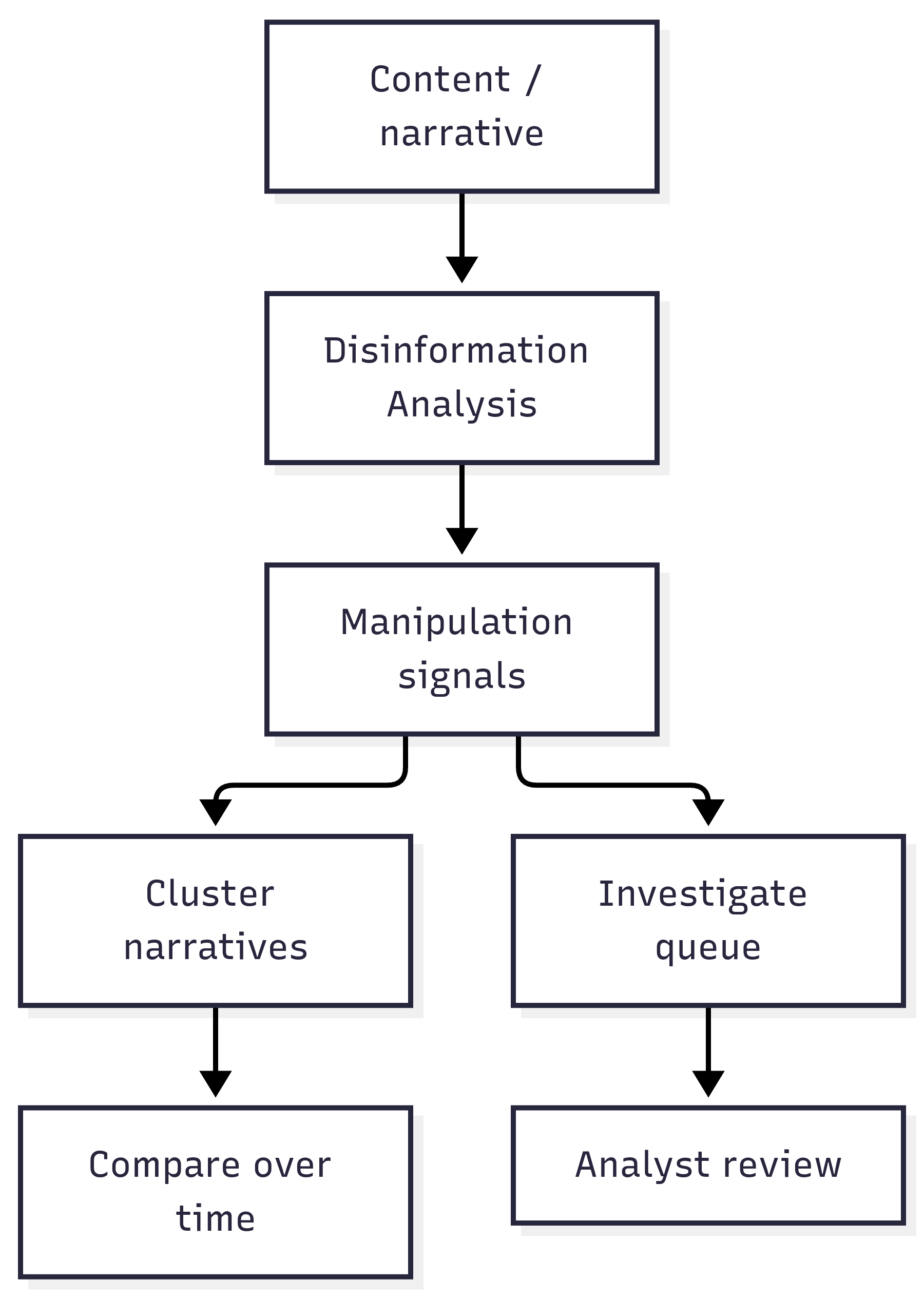
Sentiqra does not make the final decision. It supplies structured signals to the systems that do.
Stored with every decision
Request ID · configuration ID · fingerprint · policy version · action taken
You control: investigation prioritization · narrative clustering and comparison · research annotation and tracking
Before Sentiqra / With Sentiqra
| Before | With Sentiqra |
|---|---|
| Truth / false verdict | Manipulation-mechanism signals |
| Opaque flag | Named mechanism + confidence |
| One-off review | Trackable over time |
What you receive
Not a generic "unsafe" flag - structured signals your policy engine can route on.
- Manipulation-mechanism signals (urgency, suppression, authority appeal, coordination)
- Confidence scores per signal
- Versioned configuration and fingerprint
Disinformation Analysis - response preview · illustrative
Three workflows this powers
1
Investigation prioritization
Route content by manipulation mechanism, not a truth score - analysts start with the most amplified, most coordinated items.
2
Narrative clustering
Group recurring mechanisms and compare narratives across sources over time - the same technique appearing across outlets is the signal integrity teams actually want.
3
Fact-check queue input
Feed mechanism-scored items into newsroom review - the checkers decide truth, Sentiqra decides the order.
Replay any result, exactly.
Every successful analysis result carries a signed verification receipt: a configuration ID (sqcfg_...), a result fingerprint (fp2_...), an input commitment (ic3_...), and an Ed25519 signature (sig_ed25519_...). Keep them with the decision they produced - re-running the same input under the same supported configuration and output profile returns the same canonical result, whether that's an appeal next week or an audit next year.
Proof
The taxonomy covers 51 documented manipulation techniques - mechanism-level labels, not a true/false verdict.
Browse the manipulation taxonomyDisinformation Analysis on every plan - from Free (5K runs/mo) to Enterprise. See pricing →
Prove fit on your own data.
A 30-minute evaluation path: export real examples, run in parallel, compare signal quality, and replay the receipts.
- 1. Export 100-500 real examples from your workload - including the hard cases.
- 2. Label each with the outcome you actually want (route / hold / allow).
- 3. Run them through the free tier against the analyzers on this page.
- 4. Compare our signals to your labels - where we agree, where we miss.
- 5. Tune your thresholds on the misses, re-run, and confirm the improvement.
- 6. Replay the receipts to confirm identical results - that's your audit trail.
Often paired with: Crisis & OSINT Intelligence (event signals alongside manipulation) · Content Moderation (when the content also violates policy)
Detection without enforcement is the point here - teams pair this with Crisis & OSINT so the same feed produces both the event and the narrative around it.
5,000 analyzer runs/month · No card required