Sentiment tells you the news felt negative. Sentiqra tells you the company missed guidance.
Turn news, filings, transcripts, and announcements into structured event signals - earnings, guidance, corporate actions, credit events - across 8 languages including Chinese, Japanese, Hindi, and Korean.
Who it's for
Research lead
Structured event data from unstructured text.
Risk / surveillance
Consistent signals for monitoring models.
Strong fit if
- Analysts triage high-volume multilingual text
- Coverage must hold outside English
- Reports have to be reproducible later
The pipeline
Sentiqra supplies the evidence. Your systems decide what happens next.
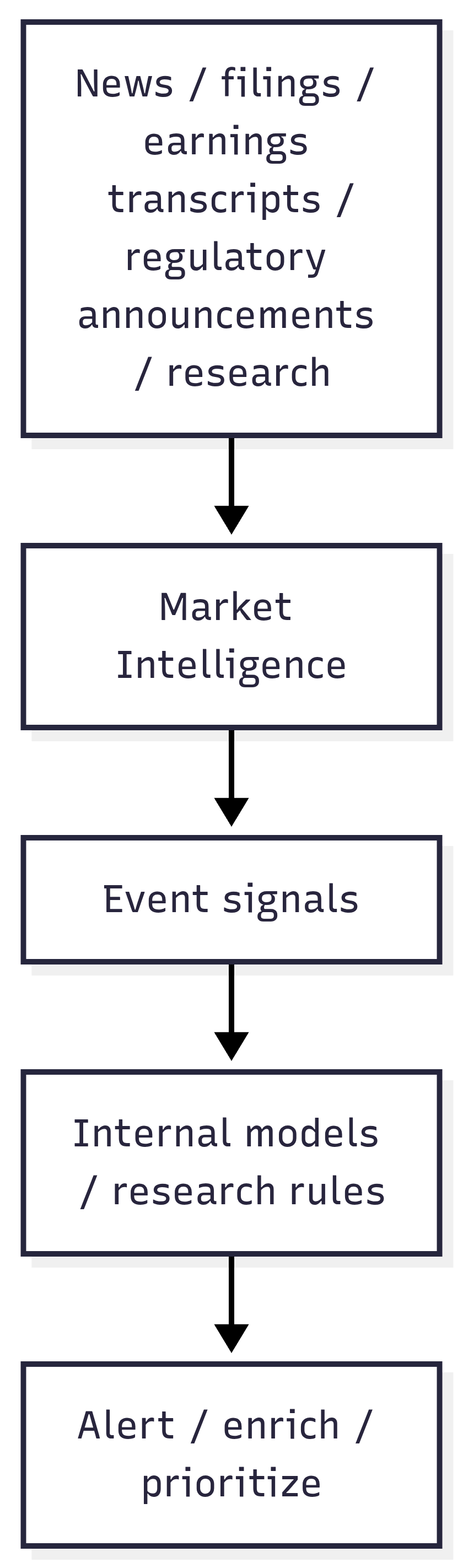
Sentiqra does not make the final decision. It supplies structured signals to the systems that do.
Stored with every decision
Request ID · configuration ID · fingerprint · policy version · action taken
You control: alerting and enrichment rules · research and portfolio workflows · surveillance and risk models
Before Sentiqra / With Sentiqra
| Before | With Sentiqra |
|---|---|
| Manual reading | Structured event signals |
| Generic classifier | Domain-specific event taxonomy |
| Ad-hoc tagging | Reproducible event data |
What you receive
Not a generic "unsafe" flag - structured signals your policy engine can route on.
- Corporate-event signals (acquisition, leadership, guidance, litigation, regulatory, capital, restructuring)
- Confidence scores per signal
- Versioned configuration and fingerprint
Market Intelligence - response preview · illustrative
Three workflows this powers
1
Systematic event pipelines
Consume typed events - guidance revisions, earnings surprises, credit actions - as features in a quant pipeline. A backtest replays against the exact analyzer behavior that generated the live signals.
2
Surveillance & compliance
Screen announcements and communications for market-relevant events under MAR-style obligations - every flag is a replayable receipt.
3
Multilingual macro monitoring
Watch central-bank statements and policy releases in Chinese, Japanese, Hindi, and Korean with the same event taxonomy as English coverage.
Every result is a receipt.
Every successful analysis result includes a signed verification receipt: a configuration ID (sqcfg_...), a result fingerprint (fp2_...), an input commitment (ic3_...), and an Ed25519 signature (sig_ed25519_...). Store them. Replay the same input under the same supported configuration and output profile and you get the same canonical result - that's how appeals hold up, audits close, and regulators get straight answers.
Proof
Event extraction, not sentiment - the comparison table on the analyzer page shows exactly what changes downstream. For MAR and DORA reviews, the receipt shows precisely which announcement wording triggered which event label when a surveillance flag is challenged three months later.
Events vs sentimentMarket Intelligence on every plan - from Free (5K runs/mo) to Enterprise. See pricing →
Prove fit on your own data.
A 30-minute evaluation path: export real examples, run in parallel, compare signal quality, and replay the receipts.
- 1. Export 100-500 real examples from your workload - including the hard cases.
- 2. Label each with the outcome you actually want (route / hold / allow).
- 3. Run them through the free tier against the analyzers on this page.
- 4. Compare our signals to your labels - where we agree, where we miss.
- 5. Tune your thresholds on the misses, re-run, and confirm the improvement.
- 6. Replay the receipts to confirm identical results - that's your audit trail.
Often paired with: Information Integrity (coordinated market narratives) · Crisis & OSINT Intelligence (geopolitical market drivers)
Compliance and research teams usually pair this with Crisis & OSINT - geopolitical events are the external drivers most market signals eventually trace back to.
5,000 analyzer runs/month · No card required