From message to decision: signals in, allow / warn / hold out.
One analyze call produces structured risk signals. Your risk router fans them out to the workflow that owns each risk, your decision engine weighs them against customer context, and every outcome - allow, warn, hold - lands with evidence attached.
Who it's for
Risk operations lead
One decisioning loop for every risk type instead of per-team inboxes.
Platform architect
A clean seam between detection and decisioning - each side stays yours.
Trust & Safety director
Evidence-backed allow / warn / hold outcomes that survive audits and appeals.
Strong fit if
- You compose several analyzers into one pipeline
- Run cost matters at scale
- Different risk types have different owners
The pipeline
Sentiqra supplies the evidence. Your systems decide what happens next.
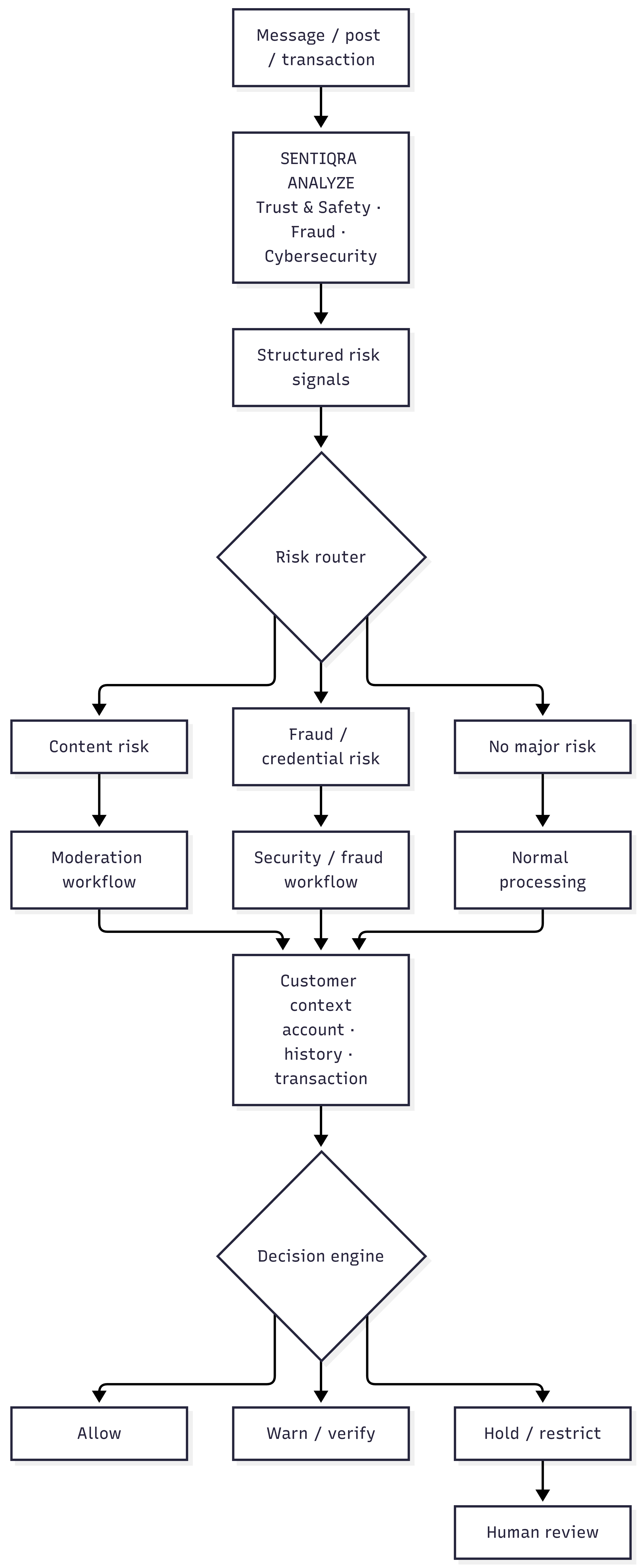
Sentiqra does not make the final decision. It supplies structured signals to the systems that do.
Stored with every decision
Request ID · configuration ID · fingerprint · policy version · action taken
You control: the risk router and its thresholds · customer context joins and decision weights · final allow / warn / hold actions · human-review scope and escalation
Before Sentiqra / With Sentiqra
| Before | With Sentiqra |
|---|---|
| One review queue for every risk | Domain-owned workflows per risk type |
| Signal-only flags | Signals weighed against customer context |
| Unexplainable actions | Receipt-backed allow / warn / hold |
What you receive
Not a generic "unsafe" flag - structured signals your policy engine can route on.
- Structured risk signals per domain
- Risk-type attribution - content, fraud, credential
- Evidence attached to every downstream action
Multi-Analyzer Pipeline - response preview · illustrative
Three workflows this powers
1
Risk-type routing
Content risk routes to the moderation workflow, fraud and credential risk to the security workflow, and clean traffic continues to normal processing - each with its own SLA.
2
Context-weighted decisions
The same signal reads differently against a new account vs. a tenured customer - your decision engine joins account, history, and transaction context before acting.
3
Graduated actions
Allow, warn/verify, or hold/restrict - proportionate to the risk, with hold cases landing in human review instead of silent enforcement.
4
Closed-loop evidence
Every action links back to the signals and configuration that drove it, so appeals and audits start from evidence, not logs archaeology.
Every result is a receipt.
Every successful analysis result includes a signed verification receipt: a configuration ID (sqcfg_...), a result fingerprint (fp2_...), an input commitment (ic3_...), and an Ed25519 signature (sig_ed25519_...). Store them. Replay the same input under the same supported configuration and output profile and you get the same canonical result - that's how appeals hold up, audits close, and regulators get straight answers.
Proof
The seam is the product: Sentiqra emits structured, signed signals - your router and decision engine keep full control of context, thresholds, and actions.
Production architecture docsEvery analyzer on every plan - from Free (5K runs/mo) to Enterprise. See pricing →
Prove fit on your own data.
A 30-minute evaluation path: export real examples, run in parallel, compare signal quality, and replay the receipts.
- 1. Export 100-500 real examples from your workload - including the hard cases.
- 2. Label each with the outcome you actually want (route / hold / allow).
- 3. Run them through the free tier against the analyzers on this page.
- 4. Compare our signals to your labels - where we agree, where we miss.
- 5. Tune your thresholds on the misses, re-run, and confirm the improvement.
- 6. Replay the receipts to confirm identical results - that's your audit trail.
Often paired with: Multi-Domain Orchestration (staged analyzer selection upstream) · Marketplace & Messaging Safety (this loop applied to marketplace traffic) · Security Operations (the fraud/credential branch in depth)
Multi-Domain Orchestration decides which analyzers run; this page decides what happens with their output. Most deployments design both together.
5,000 analyzer runs/month · No card required